
Most predictions about 2030 read like science fiction or sales decks. They talk about “AI everywhere” without explaining what that actually does to the fundamental operating system of a company, its structure, its people, its decision-making loops, its economics, and its products.
A company is a machine for turning resources (capital, talent, data, compute) into value faster and more reliably than competitors. In an intelligence-abundant world, the winning machine will not be the one that uses AI. It will be the one that is AI where intelligence is native to every process, every role, every product, and every strategic decision.
By 2030, the distinction between “tech company” and “AI company” will disappear for anyone still in business. Hi-tech software firms and multi-discipline organizations (telecom being the clearest example) will have undergone the most visible and brutal version of this rewrite. Here is what that reality actually looks like, across structure, talent, processes, products, economics, and governance.
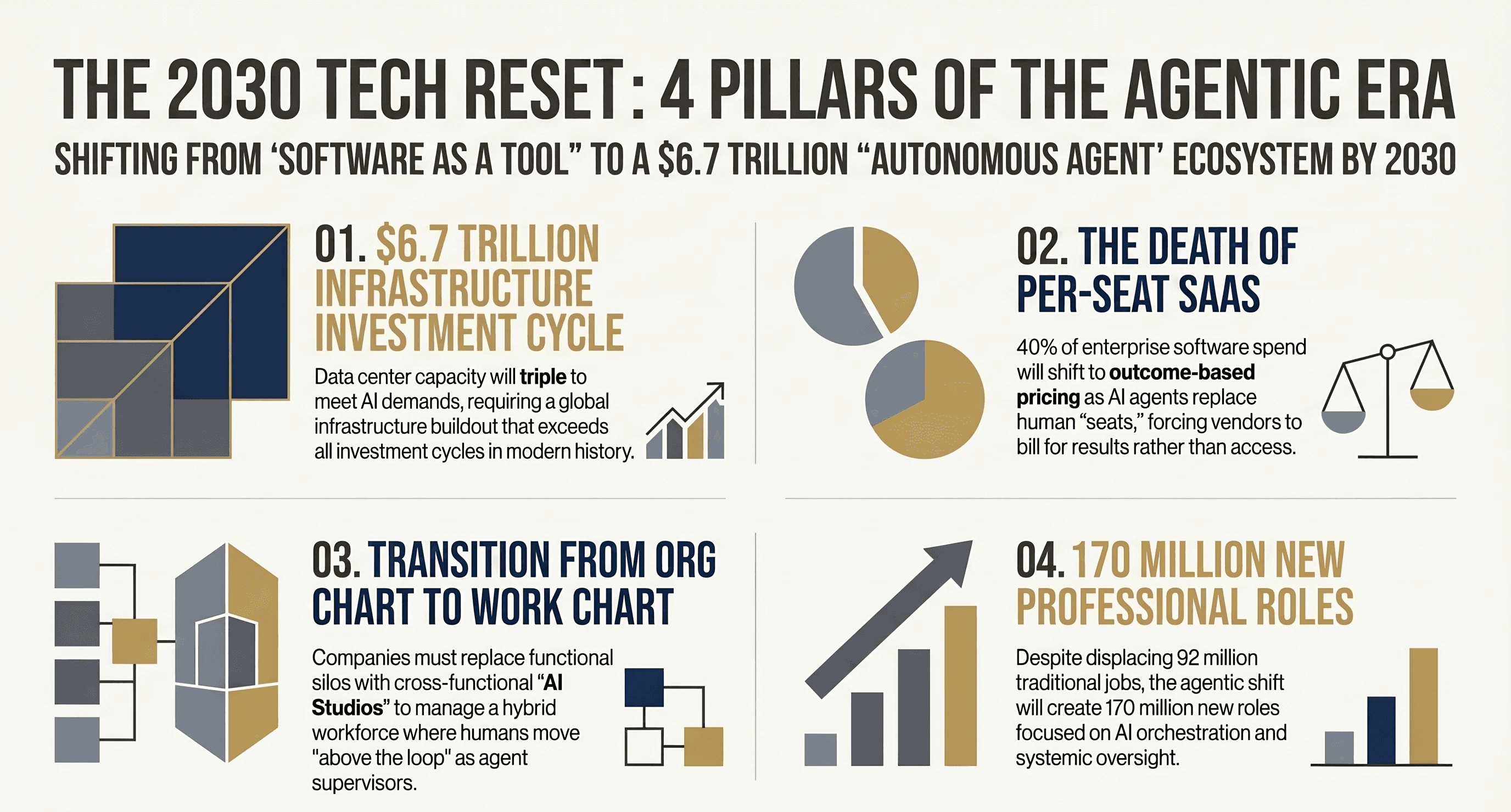
1. Organizational Structure: From Hierarchies to Agentic Platforms
The org chart of 2030 will look more like a control tower network than a pyramid.
Leading companies are already moving to platform operating models, 20–40 cross-functional platforms (customer journeys, network intelligence, product platforms, enabling services) instead of traditional departments. Each platform is owned by a small, high-agency team that combines domain experts with AI orchestration capability.
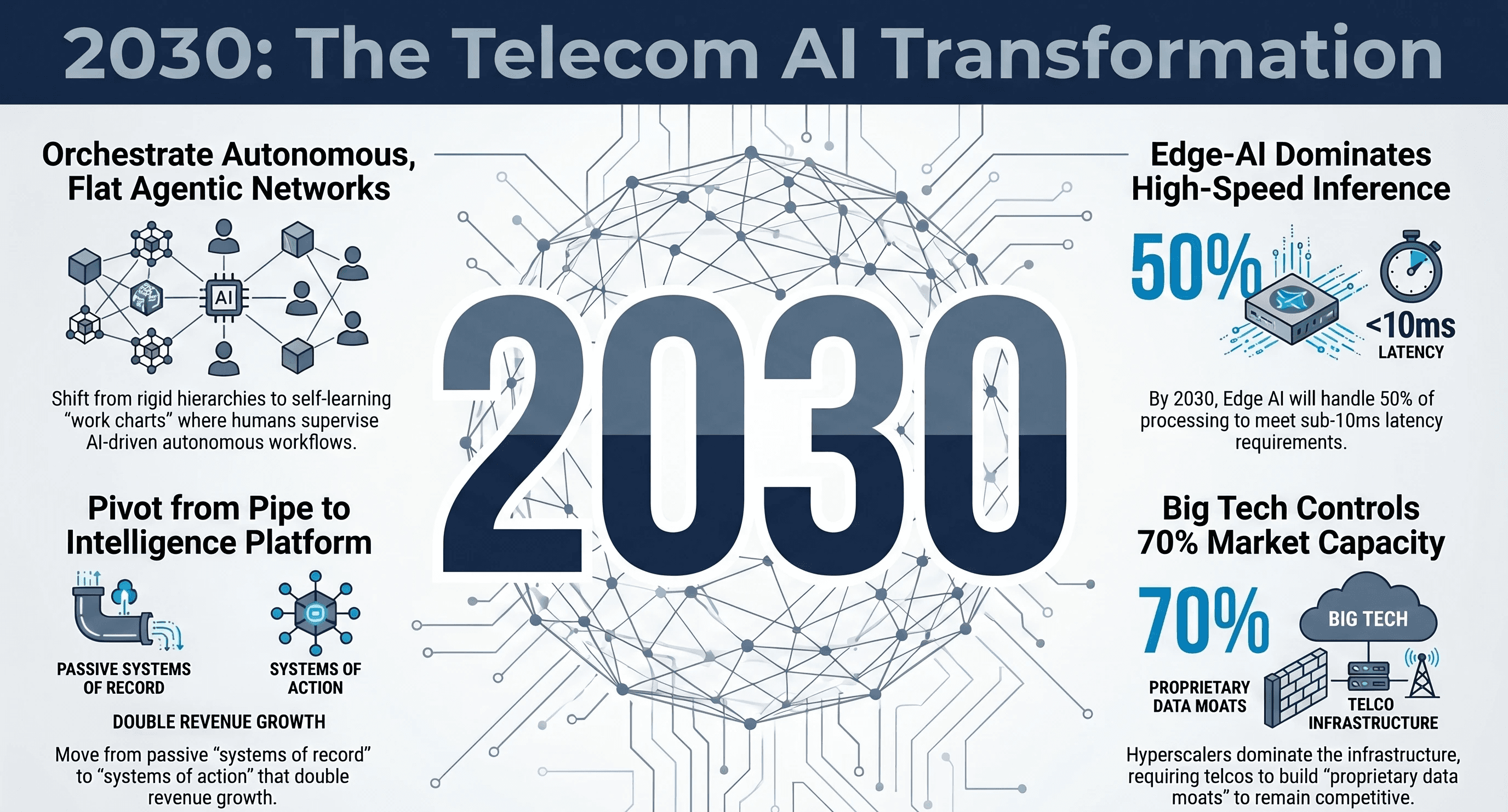
In software and R&D organizations, this means product squads no longer wait for separate “AI team” or “data team” tickets. AI is embedded in the squad. In telecom, network operations, customer experience, and service assurance converge into real-time agentic systems where decisions that once required escalation now happen autonomously within policy guardrails.
The old matrix is dead. The new structure is human + AI orchestration layers, humans design the objectives, constraints, and exception paths. AI agents execute, monitor, and optimize at machine speed. This is not theory. It is already visible in the organizations moving fastest.
2. Roles & Skills: The End of “Doing” Work, The Rise of Orchestration
By 2030, Gartner’s projection will be reality: 0% of IT and knowledge work will be done without AI. Roughly 25% will be executed by AI alone; 75% will be humans augmented by AI.
This creates three categories of roles:
AI Specialists & Orchestrators (fastest growing): AI/ML engineers, MLOps, agent designers, model governors, AI ethicists/risk leads. These people don’t just prompt, they architect portfolios of agents and the governance around them.
Domain + AI Hybrids (the majority of growth): Software architects who understand generative systems, network engineers who design self-optimizing infrastructure, product managers who treat AI agents as first-class team members, PMs who have evolved into delivery intelligence leaders.
Human-Only Premium Roles: Complex judgment, ethical trade-off navigation, high-stakes stakeholder alignment, creative synthesis that still requires genuine novelty. These roles become more valuable, not less.
Routine work collapses. Data entry, basic reporting, standard coding, first-level support, basic analysis, and much of traditional project coordination are either fully automated or reduced by 60–80%. The WEF projects 39% of core skills will be outdated by 2030.
The scarce skill is no longer “knowing how to use tools.” It is knowing how to direct intelligence at scale while maintaining truth, safety, and strategic coherence.
3. Processes: From Periodic & Manual to Real-Time & Agentic
This is where the biggest productivity delta appears.
In software organizations:
Code generation, documentation, testing, sprint reporting, risk identification, and historical pattern analysis move from human effort to AI-augmented or fully agentic workflows.
Planning and resource allocation become continuously optimized rather than weekly or monthly rituals.
In telecom and multi-discipline operations:
Networks become largely self-optimizing and self-healing. Energy management, capacity planning, anomaly detection, and many fault resolutions happen without human intervention.
Supply chain, logistics, and field operations shift to predictive and prescriptive models with agentic execution (Gartner forecasts 50% of cross-functional SCM solutions will use intelligent agents by 2030).
The new process primitive is the agentic loop: sense → decide → act → learn, running at machine speed with human oversight on objectives and exceptions. Periodic reporting is replaced by real-time dashboards and proactive intervention. “Status meetings” become exception reviews.
4. Products & Services: Intelligence Becomes the Product
By 2030, the product is the intelligence layer.
Software companies stop selling “tools with AI features”. They sell intelligent systems that continuously improve, anticipate needs, and orchestrate outcomes. Low-code/no-code explodes because AI lowers the cost of creating and maintaining software dramatically, which in turn increases demand for higher-level architects and integrators.
Telecom operators move from selling connectivity and minutes to selling guaranteed outcomes powered by AI: predictive network performance, autonomous service assurance, personalized enterprise solutions, and edge intelligence platforms. Servitization accelerates, “uptime as a service,” “resilient operations as a platform.”
The companies that win are those that embed AI so deeply that customers experience the intelligence, not the technology underneath it.
5. Financial Reality: The Great Divergence
PwC data already shows AI-exposed industries delivering 3x higher revenue-per-employee growth. McKinsey’s modeling points to trillions in aggregate value creation, with banking alone holding ~$1T annual potential and operations-heavy sectors seeing 15–40%+ cost compression in targeted areas.
By 2030 this divergence is extreme:
Leaders (those who executed structured transformation) enjoy structurally higher margins, faster innovation cycles, and compounding data advantages.
Laggards face margin pressure, talent exodus, and eventual irrelevance as customers and talent migrate to the intelligent competitors.
The economics favor the bold but disciplined. Capex in data platforms, compute, and talent is front-loaded. The return curve is back-loaded but steep, once the operating system is AI-native, marginal cost of new capability drops dramatically.
6. Governance & Risk: Non-Negotiable Foundation
The organizations that survive and thrive will have treated governance as a first-class strategic capability from day one, not an afterthought or compliance checkbox.
Shadow AI, model bias, data leakage, regulatory exposure, and loss of human judgment in critical loops are not theoretical risks. They are already material. The winners will have living AI inventories, clear data classification, agent approval processes, continuous monitoring, and genuine human accountability at the right escalation points.
This is not bureaucracy. It is the operating license for an intelligence-rich enterprise.
Why Most Transformations Will Still Fail
The failure modes are predictable and already visible:
Starting with tools instead of problems and value.
Running pilots without a clear path to scale or capability transfer.
Treating governance as optional.
Under-investing in the human side (skills, culture, change).
Confusing activity (more models, more dashboards) with transformation.
The companies that win will have done the opposite: they will have followed a rigorous, evidence-based sequence that proves value quickly while building the internal muscle to sustain it.
The Window Is Open - But Closing
The organizations that will dominate their sectors in 2030 are making these decisions in 2026 and 2027. Not with perfect foresight, but with rigorous process, measurable pilots, and relentless focus on building internal intelligence rather than renting it.
The question is no longer whether your company will change. It is whether you will lead that change deliberately or be dragged through it reactively.